Drawing Daggers, or, my experience with the 5e "successor" space
Throwing some thoughts out there discussing two buzzy games over the last year that are positioned at the Heroic Fantasy TTRPG space historically dominated by D&D. Both approach the culture in different ways, narrowing in on facilitating a specific subset of play (eg: both would say "go play Shadowdark if you want a modern take on dungeon crawling"). I don't think they're competitors per se except in the way that everybody is competing for attention, for the following reasons:
Design Ethos. Both games want you to have "dramatic" or "cinematic" play. The way they create that is very different. Draw Steel! lands in the "tactical combat tends to be the most dramatic part of the stories we want to tell" and provides robust structure for the GM and players to do this. Daggerheart tells the players and GM to "when in doubt do the most dramatic thing" across all aspects of play, providing some specific examples of consequences from Action Rolls and a narrative-twist-generating resolution mechanic to facilitate this.
"Hackability." Draw Steel! is a fairly opinionated game in its core design. What I mean by this is that elements of Colville + team's idea of what fantasy characters look like and do comes through very strongly via ability names; the ancestry builds; and the monster designs. There's a lot of purposefully non-generic-fantasy work in there, that gives some really freaking cool outcomes but also takes more work on the side of players and the GM to meld it. Daggerheart is almost painfully generic "modern heroic fantasy." Yeah, you gotta have an assumption of some sort of high-magic (or hand wave magic-as-tech as the Horizon Zero Dawn meets Mortal Engines campaign Frame does), but there's a lot more space to tweak within that. With some work I made DS! fit 4e Forgotten Realms pretty ok; with mild work I made Daggerheart work just as well for a home-brew classic D&D themed world as it does for a modern urban fantasy game in Seattle I spun up.
Resolution Systems. Both games use a 2dX system; 2d12 for Daggerheart and 2d10 for Draw Steel!, with the former having a combination of "by 5s" difficulties presented by the book; and also scaling targets on adversary and environment profiles. Draw Steel!'s targets are immutable - <=11 is always the worst outcome, 12-16 ok, higher best. Daggerheart uses a spin on Advantage/Disadvantage by having an additional d6 you roll to add/subtract - multiple sources mean you roll and take a "best of"; while DS! uses a system of Edges/Banes which are either a +/- 2 OR an entire success tier higher or lower with a double stack.
In play, they're not that dissimilar, at least how I ran it. DS! has a long list of skills which grant +2 to attribute rolls and give characters some good differentiation, whereas Daggerheart has the characters slowly adding more and more "experiences" to their repertoire via level ups which are a more free-form expression of who that character is, but cost a metacurrency to add to your rolls. DH does want you to use Experiences as a form of fictional permission as well ("of course you can do X due to your class/experience/etc"); DS! has permissions tied to ancestry + class as well ("my Human can sense the unnatural at will"). Both ultimately come down to declaring a desire to something, working out what stat + experience/skill, and resolving. DH adds an additional axis (success/failure; hope/fear) to drive narrative twists; DS! does that up front by the GM setting the test difficulty (easy/medium/hard) and having suggested consequences and such based on that. DH has a fair bit of GM side scaffolding following in the footsteps of PBTA and FITD ethos around "establishing stakes" etc, via the concept of various styles of GM "Moves" you make on outcomes. Both games emphasize the idea of "fail forward" or not grinding progress of the narrative to a halt on a failure.
Combat as Story. DH does streamlined 5e-esque combat, with generalized ranges (melee/close/far/etc); mild mechanics; limited conditions; and an emphasis on flavor. Works great on a roughed in sketch or theater of the mind. DS! does a huge refinement pass over 4e D&D's style of highly grid-based positional play with an emphasis on forced movement as the coolest thing (see: all the rules around smashing people into/through things). DS! does an incredible job making the abilities heroes and monsters use have a natural narration / cinematic expression by combining flavor + mechanics. My favorite example is this, the moment I read the title & saw the mechanics I immediately knew what this would look like on the battlefield:
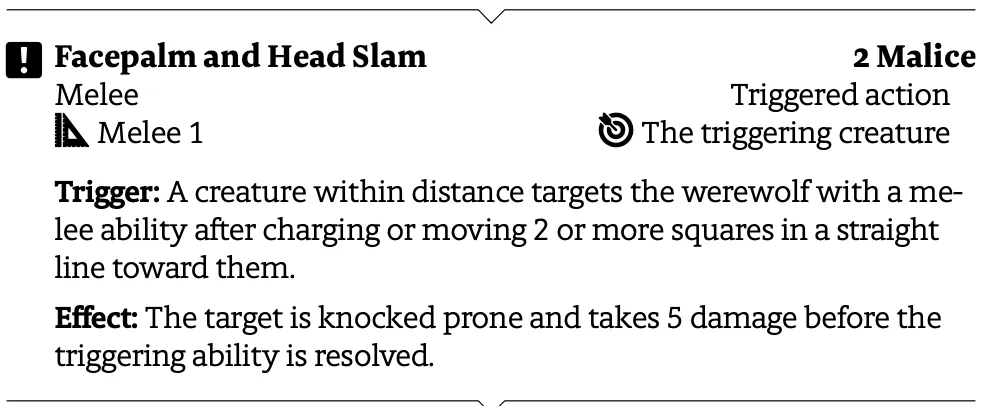
- Daggerheart leans into pared down natural language, trying to evoke some good flavor without adding too much explicit stuff to most of its abilities. Again, trying to keep things open for re-skinning and flexibility. I think this leads to somewhat less scaffolding inherent to the system when it comes to narrating cool stuff or having a mental image spring forth:

On the flip side, it's really easy to make adversaries and features for DH! They put out an entire Homebrew kit that helps there, and plenty of guides online. DS!'s far more stringent math and complex design space works against it there. It also has no assumption of "we're in combat now" or initiative, so you can seamlessly transition from talking to running to fighting to running etc.
TLDR: Daggerheart takes what I would term the "modern 5e play culture" a la Critical Role et al, focused on dramatic character moments around all pillars of play and builds a system out of the best of a number of other games it acknowledges to support that. Draw Steel! refines the crap out of 4e D&D and creates a system that will give you the cinematic tactical combat it promises, but wants you to learn lots of rules to get there.
Bonus Round, Social Challenges: Both games have scaffolding for detailed social encounters. DS! does this via the Negotiation system, which is pretty cool for "talking people into coming around to why your idea is worth their effort." DH has the idea of Social Adversaries which have Motive & Tactics in a social setting, and use their Stress marker to provide a multi-step resolution. The former hits the "back and forth with NPC motivations" really well, but needs to be used only in the "neutral to uninterested" tiers to have any chance of failure; the latter is a bit more open and has some interesting ideas of custom social-moves from sidelines NPCs.